
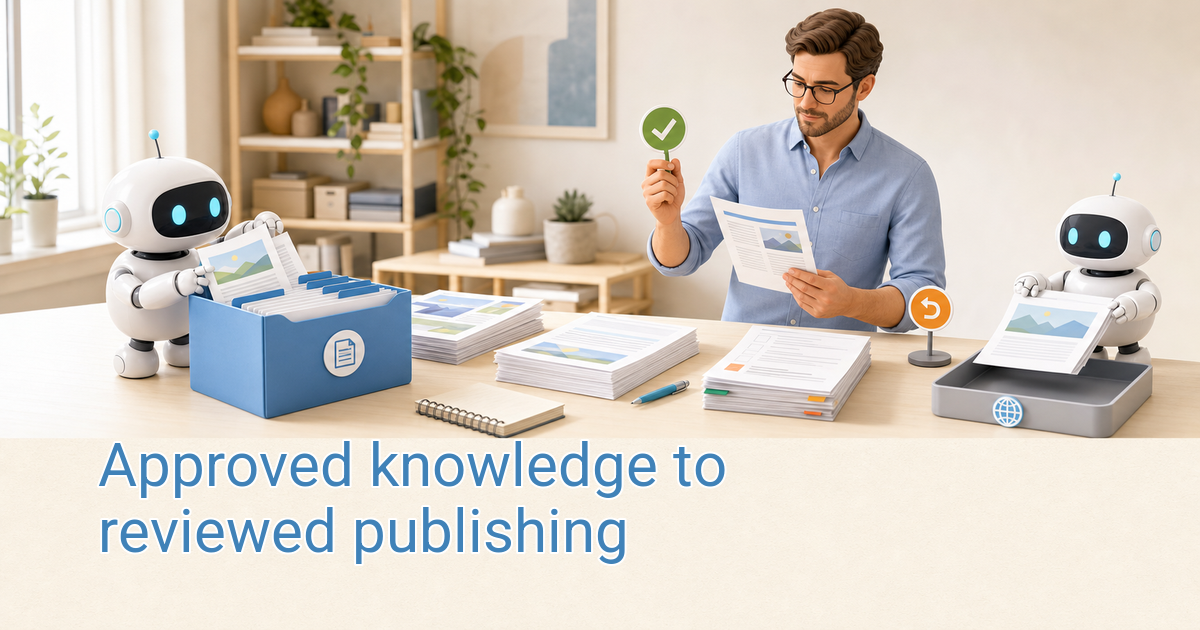
How KeepSolid Automations Turns Approved Knowledge Into a Reviewed Content Publishing Workflow
Publishing regularly is rarely just a writing problem. Teams may have product notes, campaign context, subject-matter input, brand rules, and past articles, yet still struggle to move approved knowledge into a publishable piece. The handoffs become scattered, ownership is unclear, and a draft can reach the next step without the context a reviewer needs.
A well-designed content publishing workflow gives those handoffs shape. It helps a team move from permitted research and source material to drafts, review, and authorized publishing without treating content as an unattended output. KeepSolid Automations approaches this as a managed service designed around a client’s inputs, rules, owners, approvals, exceptions, and desired outputs.
Start with approved knowledge, not an empty prompt
Useful automation begins with deciding what the process is allowed to use. For a marketing team, that may include approved product information, editorial guidance, campaign goals, source material, and existing brand assets. It may also include rules for what must be routed to a person before it can become public.
That foundation matters because a draft is only as dependable as its source material and the way uncertainty is handled. KeepSolid Automations can support topic or keyword research and prepare blog, social, or email drafts from approved knowledge. It can also adapt approved content for different uses. It does not remove the need to decide which sources are current, what a claim means, or whether a public statement is ready to publish.
The practical question is not “How do we generate more words?” It is “Which knowledge is approved, who owns it, and what should happen when the workflow cannot answer confidently?”
Map the process before automating it
The strongest content marketing workflow is usually tailored to work people already do. Before a process is designed, a team can identify:
- the event that starts the work, such as an editorial decision, product update, or campaign need;
- approved inputs and the person responsible for them;
- rules for audience, tone, prohibited claims, and required evidence;
- reviewers who can approve, request changes, or escalate an issue;
- exceptions such as missing source material or ambiguous product language; and
- the final authorization needed before an external channel receives content.
This is where a managed service differs from a generic template. KeepSolid Automations can help turn a team’s real process into defined steps and handoffs. Predictable steps may use deterministic rules, while bounded AI assistance can help interpret approved inputs or prepare structured drafts. When confidence is insufficient or an exception appears, the process should route the work to a named owner rather than guess.
Make the content approval workflow explicit
A content approval workflow should make it obvious who can make which decision. The workflow can prepare a draft and route it with relevant context, but reviewers still need enough authority and time to accept it, return it, or ask for clarification.
A review path may separate:
- Brand and editorial fit: Does the piece reflect the intended audience, voice, and message?
- Factual and product review: Are statements supported by approved knowledge, and are limits represented fairly?
- Final publication authorization: Has the accountable owner approved this public statement for the intended channel?
These are operating choices for the client, not a promise that automation can validate every claim. A responsible workflow keeps the underlying evidence available to reviewers and makes the return path visible, so a requested revision does not disappear into a disconnected thread.
Treat the content review process as an exception path too
A content review process is not valuable only when everything looks ready. Its value is often clearest when something is incomplete: a source has changed, an approved message does not fit the audience, or a reviewer needs to resolve an ambiguous statement.
KeepSolid Automations can organize those cases around defined rules and owners. A workflow might hold a draft for review, attach approved source context, route a question to the right person, and keep the next step from proceeding until the appropriate decision is made. The point is not to simulate judgment. It is to make the team’s judgment easier to apply consistently and preserve a clear record of the handoff.
What a reviewed publishing path can look like
For a marketing and growth team, the process can follow a simple sequence:
- Gather permitted topic, keyword, product, or public-source evidence.
- Create a brief and channel-appropriate drafts from approved knowledge.
- Send the material through the team’s review and return path.
- Publish or schedule approved material through validated channels.
- Collect the performance signals the team has defined for ongoing review.
This is not a promise of a fixed implementation or universal setup. The appropriate design depends on tools, permissions, data, process stability, risk level, and business requirements. The useful outcome is a repeatable operating process in which human owners keep control of claims and final publication.
Build a marketing content operation workflow around ownership
A marketing content operation workflow works best when roles are designed as carefully as the draft steps. Someone should own the source knowledge. Someone should own the process. Reviewers should have a clear decision right. A person should be able to pause the workflow if a rule, source, or channel needs attention.
KeepSolid Automations can help a business evaluate a repeatable process that fits its current operation. Discovery can focus on where work begins, which knowledge is approved, who must review public statements, what exceptions need escalation, and which channels can be validated for authorized publishing. The goal is a managed workflow that supports accountable marketing work—not a claim that a machine can replace it.
Questions teams often ask
Is this a self-service content publishing tool?
No. KeepSolid Automations is a managed automation service. The work begins with the client’s process and can combine defined workflow logic with bounded AI assistance and human review where interpretation or authorization is needed.
Can a workflow publish content without a reviewer?
The process should preserve named human ownership for claims and final publication. Content may be prepared, routed, published, or scheduled through validated channels only according to the client’s approved rules and authorization path.
What should a team prepare for an initial conversation?
Bring an example of the current content process: the trigger, approved inputs, people involved, review points, common exceptions, desired outputs, and the point at which a public statement is authorized. That gives the team a practical starting point for evaluating a repeatable workflow.
Turn careful content work into a repeatable process
If your team has approved knowledge but a fragmented path from idea to publication, start by mapping the current handoffs and decision points. KeepSolid Automations can help you assess a managed, reviewed content process built around your rules, owners, and exceptions—so drafting support and validated-channel publishing remain connected to accountable human decisions.